The short answer
Bodai-Sancha (菩提酸茶) is a lacto-fermented Japanese tea produced in the Bodai district of Toyosawa, Fukuroi City, Shizuoka Prefecture. It is made using a method developed from 2019 onward by the Bancha Research Group (晩茶研究会), under the guidance of Dr. Satoshi Matsushita, former professor at Aichi University and a leading scholar of regional Japanese tea traditions. The name combines “Bodai” (the place), “san” (acid — san, sour), and “cha” (tea). It is not a kombucha. It is not a vinegar tea. It is a post-fermented tea, a category Japan has been making for generations — with a new method developed for the steaming-equipment infrastructure of modern Shizuoka tea producers.
Origin · Bodai district, Toyosawa, Fukuroi, Shizuoka, Japan
First produced · 2019 (Bancha Research Group)
Category · Post-fermented tea / lacto-fermented tea
Method · Steamed leaf, lactic acid fermentation, no koji, no SCOBY
Sugar added · None
Recognition · World Green Tea Contest 2020 (Special Award), Japanese Tea Selection Paris 2020 (Silver Medal, Other Category)
Bodai — the place
The Bodai district sits on the slopes above Toyosawa in Fukuroi City, in the eastern part of Shizuoka Prefecture — the heartland of Japanese tea. Bodai is an old place name. It is no longer used as a formal administrative name, but it survives in local speech and is registered in the Shizuoka Prefecture Cultural Resources Database as a recognized tea-growing area under its historic name. The decision to use that historic name for the new tea was deliberate: it carries the place, the inheritance, and the responsibility of working fields that previous generations cultivated.
The stone, the calligraphy, the inheritance
At the edge of the original kancha field stands a stone monument erected by former Shizuoka Governor Shigeaki Saitō. Carved on it are four characters from the Thousand Character Classic (千字文), a calligraphy primer composed in the Liang dynasty of China: “Kinsō Ruiken” (欣奏累遣) — Joy arrives, troubles vanish. The phrase carries forward into the Bodai-Sancha package, designed by world-renowned calligrapher Hiroko Ōsugi, born in Fukuroi and rooted in the local calligraphy tradition that produced figures like Gizan Kawamura. After visiting the field and the monument, Ōsugi proposed expanding the design beyond the literal kanji Bodai-Sancha to incorporate Mt. Fuji and the syllables o-cha — a wider symbol agreed by the group.
Japan’s family of post-fermented teas
For most Western readers, the term “fermented tea” calls up kombucha — the SCOBY-fermented, sugar-sweetened drink common in cafés and supermarkets. But Japan’s fermented-tea tradition is older, narrower, and entirely different. It is made of leaves, not liquid; uses lactic acid bacteria or koji mold, not a SCOBY; and adds no sugar at any stage.
Until recently, the family of traditional Japanese post-fermented teas had four well-known members:
- Awa Bancha (阿波晩茶) — Tokushima Prefecture. Boiled, kneaded, packed wet in wooden barrels and lacto-fermented under its own juice for a month, then sun-dried.
- Goishi-cha (碁石茶) — Kochi Prefecture. A two-stage tea: koji-mold first, then lacto-fermented. Pressed into small squares like Go stones.
- Ishizuchi Kurocha (石鎚黒茶) — Ehime Prefecture. A two-stage koji-then-lactic-acid tea, distinct in character from Goishi-cha.
- Batabata-cha (バタバタ茶) — The Hirudani district of Asahi, Toyama. A koji-only post-fermented tea, traditionally whisked into a foam before drinking.
To that list, the Bancha Research Group set out to add a new lacto-fermented member: Bodai-Sancha. (A separate lacto-fermented tea, Yamano-hakkō-bancha from Oita Prefecture, is also gaining recognition.)
Japan’s post-fermented tea family is small. Adding a new member is rare. Bodai-Sancha is the newest.
How the project began
The Bancha Research Group was formally founded on 30 March 2019, at the call of Dr. Satoshi Matsushita, one of Japan’s foremost researchers on regional teas. Its founding statement laid out a difficult truth: leaf-tea consumption was declining, wholesale prices were stagnant, and the Japanese tea industry — long dominated by umami-focused sencha — risked gradual collapse. But the group argued there was a path forward in the country’s old, regional bancha teas — in particular the post-fermented teas that predate sencha. To rediscover them, expand them, and bring them to modern attention was, in the group’s view, one way to revive the broader Japanese tea industry.
The first project was ambitious: to recreate Awa Bancha in Shizuoka. In August 2019, twenty members gathered at a tea garden in Toyosawa owned by Anma Seicha, hand-picked 24kg of fresh leaves in 90 minutes, boiled them, kneaded them, packed them into two barrels (one wood, one plastic), and waited a month. Two days of sun-drying followed.
The first failure
The result was disappointing. The acidity was faint. The flavor was thin. Authentic Awa Bancha, by comparison, has deep, complex acidity and a clean aromatic finish. The Bodai team’s first batch had neither.
Several causes were identified after the fact. Too much of the boiling water — the very liquid that should have carried catechins and minerals into the fermentation barrel — was lost during transfer. The kneading produced unexpected foaming, with saponins from late-summer tea-flower buds disrupting the anaerobic environment. And Shizuoka’s tea-growing environment, dominated by the cultivar Yabukita grown at industrial scale, simply did not host the same microbial diversity as Tokushima’s smaller, more biodiverse farms.
Awa Bancha had perfected its method through generations. The Bodai team had one summer. The result was honest: a failure, but with the faintest trace of acidity. That was enough to continue.
The breakthrough: a steamed-leaf method
After studying the literature on fermentation and lactic acid bacteria, the group made two strategic decisions. First, they would abandon the boiling step entirely and instead steam the leaves — using the kind of band-conveyor steaming equipment that every Shizuoka tea producer already owns. This avoided the nutrient loss of boiling and used infrastructure already at hand. Second, they would skip the koji-inoculation step used by Goishi-cha and Ishizuchi Kurocha, relying instead on the lactic acid bacteria naturally present on the leaves and in the production environment.
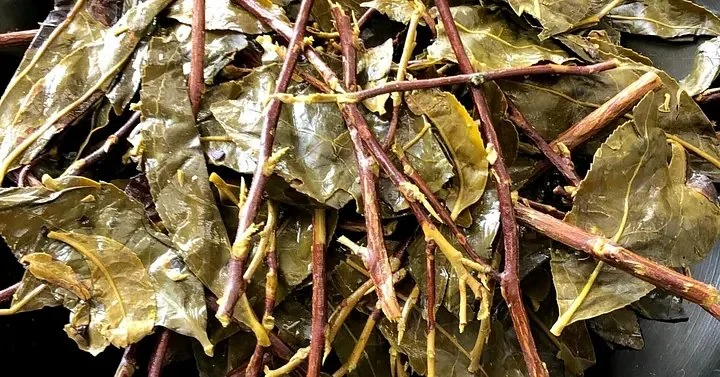
Steamed, kneaded leaves were packed in October 2019 using autumn-harvested akifuyu-bancha. Within weeks, the result was unlike anything the group had tasted: a clean, citrus-edged acidity, with the body and structure that the first failed attempt had lacked. At a tea-culture lecture at Mellow Plaza in Fukuroi, the public tasted it. The response was unanimously positive.
The winter-tea production line
With the method proven, the group moved to scale. They chose kancha — tea picked at the coldest point of winter, around Daikan in late January — as the production base. The choice was deliberate: the field they selected was an abandoned tea garden on the slopes near the Bodai stone monument, one of the gardens the group had identified as a model case for tea-garden revival. Producing a marketable tea from a previously-abandoned field served the group’s broader mission as well as the immediate product.
The first commercial-scale kancha batch was picked in late February 2020 and fermented for four months. That batch was submitted to the World Green Tea Contest 2020, where it won a Special Award. Later that year, the same tea won a Silver Medal (Other Category) at Japanese Tea Selection Paris 2020.
Ikeda Yoshimasa (Ikeda-en) · tea producer, Toyosawa
Anma Kosuke (Anma Seicha) · tea producer, Toyosawa
Takahashi Akihiro (Takahashi Seicha) · tea producer, Toyosawa
Tatara Takayuki (Nagamine Seicha) · tea merchant, Yaizu
Under the founding guidance of Dr. Satoshi Matsushita.
How it’s consumed today
Bodai-Sancha is rarely served as a finished consumer beverage in its leaf form. It is most commonly sold as:
A raw material for craft beverages
Bodai-Sancha leaves (whole leaf and powder) are sold as a B2B ingredient to craft beverage producers, restaurants, and beverage program developers building unsweetened, lactic-acid-led drinks — a category that has almost no presence on the Western market apart from kombucha.
A finished sparkling tea
Nagamine Seicha produces bodhi — a sparkling tea made from Bodai-Sancha. Brewed, carbonated, glass-bottled. Sugar-free, alcohol-free, zero-calorie. Designed to pair with Japanese, Western, Chinese, and other cuisines — and to share the dinner table with wine, sake, and spirits as a serious non-alcoholic alternative. The production method received Japanese Patent No. 7085174 in 2022, and the product was exhibited at World Tea Expo Las Vegas in May 2026.
Why it matters now
Global interest in non-alcoholic dining has created demand for beverages that pair seriously with food. The dominant category, kombucha, is sweetened and acetic. Bodai-Sancha offers a fundamentally different profile: lactic-acid acidity, zero added sugar, dry finish, citrus-edged aromatics. It is the only Japanese post-fermented tea designed from the start around modern Shizuoka tea-processing infrastructure, meaning it can scale where the older artisanal teas of Tokushima and Kochi cannot.
For specialty importers, fine-dining restaurants, hotel beverage programs, and craft drink developers, Bodai-Sancha represents a category opening: rooted in a long-running Japanese fermented-tea tradition, modern in execution, and available at commercial volume.
For B2B partners
Nagamine Seicha is the commercial distribution partner for Bodai-Sancha and the producer of bodhi sparkling tea. We supply:
- Bodai-Sancha leaves — whole leaf and powder, as a raw material for B2B fermentation, blending, and beverage development programs
- bodhi sparkling tea — finished product, 200ml glass bottle, ambient-stable, sugar-free, alcohol-free, zero-calorie
MOQ starts from 1kg for leaves and 1 case for sparkling tea. Documentation including COA, residue analysis, and certificate of origin is available on request. FOB Yaizu / CIF Bangkok / DDP available.