The TL;DR for buyers
Kombucha: Western-style fermented tea drink. SCOBY-fermented from sweetened tea liquor. Added sugar (residual 2–8g/100ml). Often trace alcohol (under 0.5%). Vinegar-like acidity.
Same category — fermented tea beverages. Different worlds.
1. What’s actually in the bottle
Kombucha
Kombucha is made by brewing sweetened tea (typically black tea + cane sugar or honey) and inoculating it with a SCOBY — a Symbiotic Culture of Bacteria and Yeast. The SCOBY ferments the sweetened liquor over 7–30 days at room temperature. Yeast converts sugar to alcohol; bacteria converts alcohol to acetic acid. What ends up in the bottle is the resulting fermented liquid — partially sweetened, partially acetic, sometimes slightly alcoholic. Carbonation is either natural (from continued fermentation) or added.
bodhi
bodhi is made from Bodai-Sancha leaves, a lacto-fermented Japanese tea (the leaves themselves are fermented for four weeks, then dried and aged for approximately one year before brewing). Those finished leaves are brewed with water — no sugar added — to produce a base liquor. The liquor is carbonated and sealed in a 200ml glass bottle. What ends up in the bottle is brewed Bodai-Sancha tea with bubbles — clean, dry, unsweetened, fully non-alcoholic. The acidity comes from the lactic acid already present in the fermented leaves; no further fermentation happens in the bottle.
Kombucha is sweetened tea, fermented in the bottle. bodhi is fermented tea, brewed and carbonated. Both are fermented tea beverages. They are made completely differently.
2. Sugar — the deal-breaker
Kombucha needs sugar
Kombucha’s SCOBY requires sugar to function. The yeast eats the sugar, produces alcohol, which the bacteria then convert to acetic acid. Without added sugar (typically cane sugar or honey), the fermentation cannot start. Commercial kombuchas typically contain 2–8g of residual sugar per 100ml even after fermentation, because some sugar always remains. Many flavored kombuchas add fruit juice on top of that, raising the total sugar further.
bodhi has none
bodhi’s fermentation happens entirely before brewing — in the leaves, not in the bottle. The lactic acid bacteria in the Bodai-Sancha leaves consume the naturally occurring carbohydrates of the tea leaves themselves, during four weeks of anaerobic lacto-fermentation at room temperature. By the time the leaves are brewed into bodhi’s base liquor, essentially zero sugar remains. No sugar is added at brewing, carbonation, or bottling. The finished bottle has zero residual sugar and zero calories.
3. The acidity profile
Kombucha — acetic acid
Kombucha’s acidity comes primarily from acetic acid, the same compound that gives vinegar its flavor. On the palate, it reads as “vinegary,” “sharp,” or “medicinal.” Some find it pleasant; others find it polarizing. Many commercial kombuchas mask the acetic edge with fruit juice, sweeteners, or extra carbonation.
bodhi — lactic acid
bodhi’s acidity comes from lactic acid, which is softer, rounder, and more wine-like on the palate. It registers as a clean, dry tartness — closer to the acidity of a crisp white wine or aged sake than to vinegar. This is the same compound that defines good yogurt, sourdough bread, and aged cheese.
4. Alcohol
Kombucha
Kombucha contains trace alcohol from yeast fermentation. Most commercial kombuchas remain under the 0.5% threshold and are sold as non-alcoholic, but they are not zero alcohol — the yeast keeps working in the bottle, and home-brewed or extended-fermentation kombuchas can exceed 1% or 2% ABV. In some jurisdictions, kombucha distribution and licensing are regulated accordingly.
bodhi
bodhi contains zero alcohol. The fermentation is purely lactic (not yeast-driven), happens entirely in the leaves before brewing, and is complete before carbonation. There is no living culture in the bottle, no yeast, no continued fermentation, no alcohol production at any stage. bodhi is suitable for strictly non-alcoholic beverage programs — including hotel halal-certified service, religious dietary settings, and pregnancy-safe menus.
5. Origin and tradition
Kombucha
The origin of kombucha is disputed. Some sources trace it to Manchuria around 220 BCE; others to 19th-century Russia. Either way, it entered the modern Western consumer market in the 1990s and exploded as a packaged beverage in the 2010s — positioned primarily as a probiotic health drink. It is, in commercial terms, a modern Western category.
bodhi
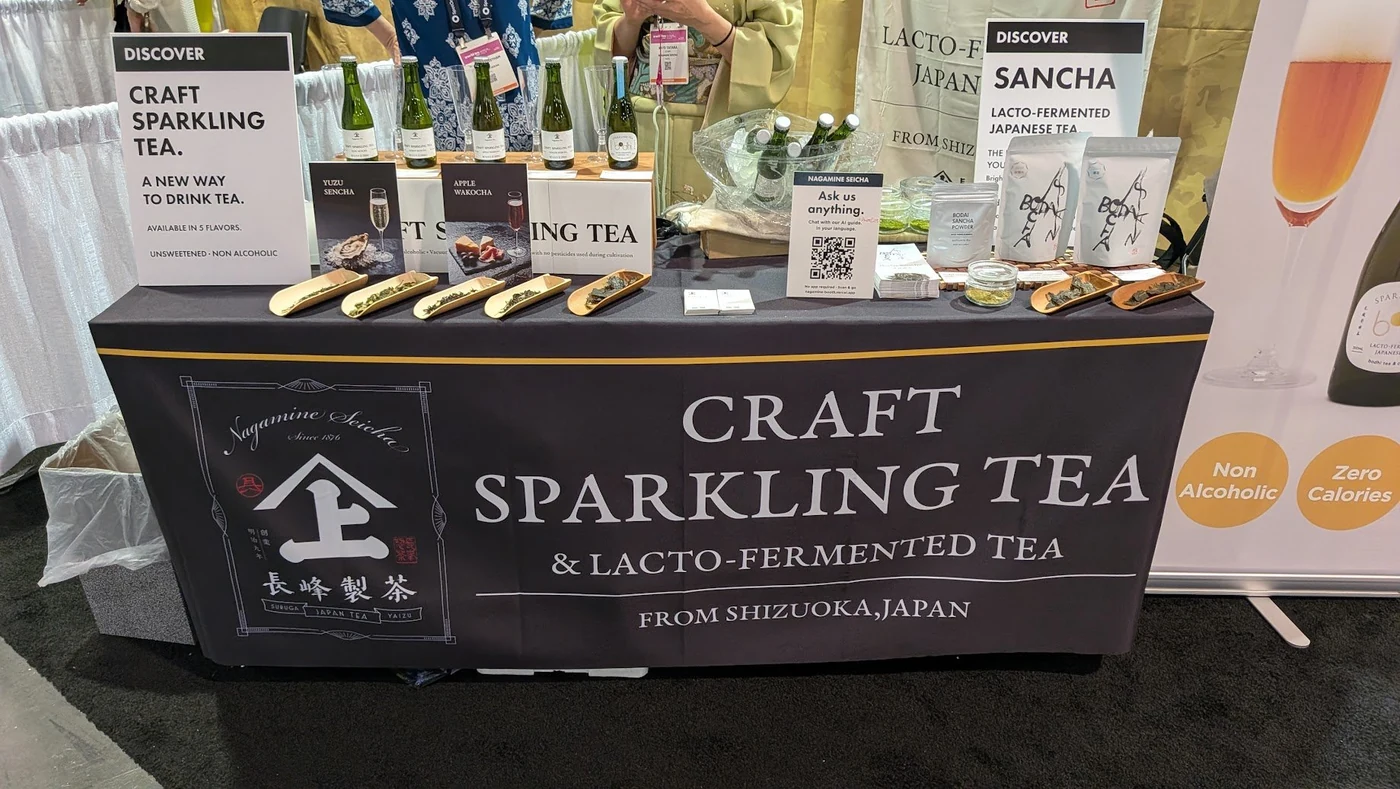
bodhi is a contemporary Japanese craft beverage, developed by Nagamine Seicha from 2019 onward. Its production method received Japanese Patent No. 7085174 in 2022, and bodhi was exhibited at World Tea Expo Las Vegas in May 2026. The base ingredient, Bodai-Sancha, is a lacto-fermented tea developed in the same period by the Bancha Research Group, joining the small family of traditional Japanese post-fermented teas — awa bancha, goishi-cha, ishizuchi kurocha, batabata-cha. The drink is new; the fermentation tradition behind it is part of Japan’s long-standing post-fermented tea lineage.
6. How they’re positioned commercially
Kombucha — health drink
Kombucha is overwhelmingly sold as a finished consumer beverage in supermarket coolers, often heavily flavored with fruit, marketed on probiotic health claims. The category is dominated by a few large brands in Western markets. Common serving contexts: grab-and-go cooler, juice bar, wellness retail, casual café.
bodhi — dining beverage
bodhi is positioned for the dining table. Unsweetened. Non-alcoholic. Designed to occupy the role of dry champagne, dry sake, or natural wine in a serious beverage program. Common serving contexts: fine-dining tasting menu pairings, hotel non-alcoholic programs, sushi counter pairings, sake-bar non-alcoholic alternatives, ambient-stable hospitality service.
Side-by-side summary
| Aspect | Kombucha | bodhi |
|---|---|---|
| Fermentation | In-bottle, SCOBY (yeast + bacteria) | Pre-brew, lacto-fermentation of leaves |
| Sugar added | Required (cane sugar or honey) | None at any stage |
| Residual sugar | 2–8g / 100ml typical | Essentially zero |
| Alcohol | Trace (typically <0.5%, can exceed 1%) | 0%, suitable for strict non-alcoholic |
| Calories | ~20–50 kcal / 200ml typical | Zero |
| Dominant acid | Acetic acid (vinegar-like) | Lactic acid (wine-like) |
| Origin | Disputed (Manchuria / Russia) | Yaizu, Shizuoka, Japan |
| Commercial position | Probiotic health drink / cooler | Dining-table beverage / pairing |
| Patent / Certification | N/A (commodity category) | JP Patent No. 7085174 (2022) |
Which one fits your program?
If you’re building a sweet, flavored, probiotic-positioned beverage program, kombucha is the established category — well-distributed, mass-marketed, familiar to consumers. If you’re building an unsweetened, food-pairing, wine-adjacent beverage program — or you simply want a fermented sparkling drink that no one else has — bodhi is the answer. The two are not in direct competition; they answer different questions.
For specialty importers, fine-dining beverage programs, hotel non-alcoholic offerings, and craft drink developers exploring the next chapter of fermented beverages, bodhi offers something kombucha cannot: an unsweetened, dry, lactic-acid sparkling drink with zero alcohol, zero calories, and a patented Japanese production method rooted in the broader Japanese post-fermented tea tradition.
Want to learn more?
For the full story of how bodhi came to be — including the four-year development of the Bodai-Sancha base ingredient — read What Is Bodai-Sancha?. For pricing, MOQ, and shipping terms, see the bodhi product page or contact us directly.